What barriers and facilitators influence international student drivers’ decisions to adopt sustainable MaaS solutions?
PhD exegesis, Monash Art, Design and Architecture, 2026
Envisioning future sustainable mobility.
Participatory action design research co-developing a campus Mobility-as-a-Service concept with international student drivers.
Research question
From policy ambition to daily travel decisionsHow might design research and practice enhance the digital experience of a future Mobility-as-a-Service platform for international students to facilitate sustainable travel decision-making?
How can participatory design produce actionable knowledge about mobility needs, trust and adoption?
How can design practice transform lived mobility insights into interventions that promote sustainable commuting?
Research framework
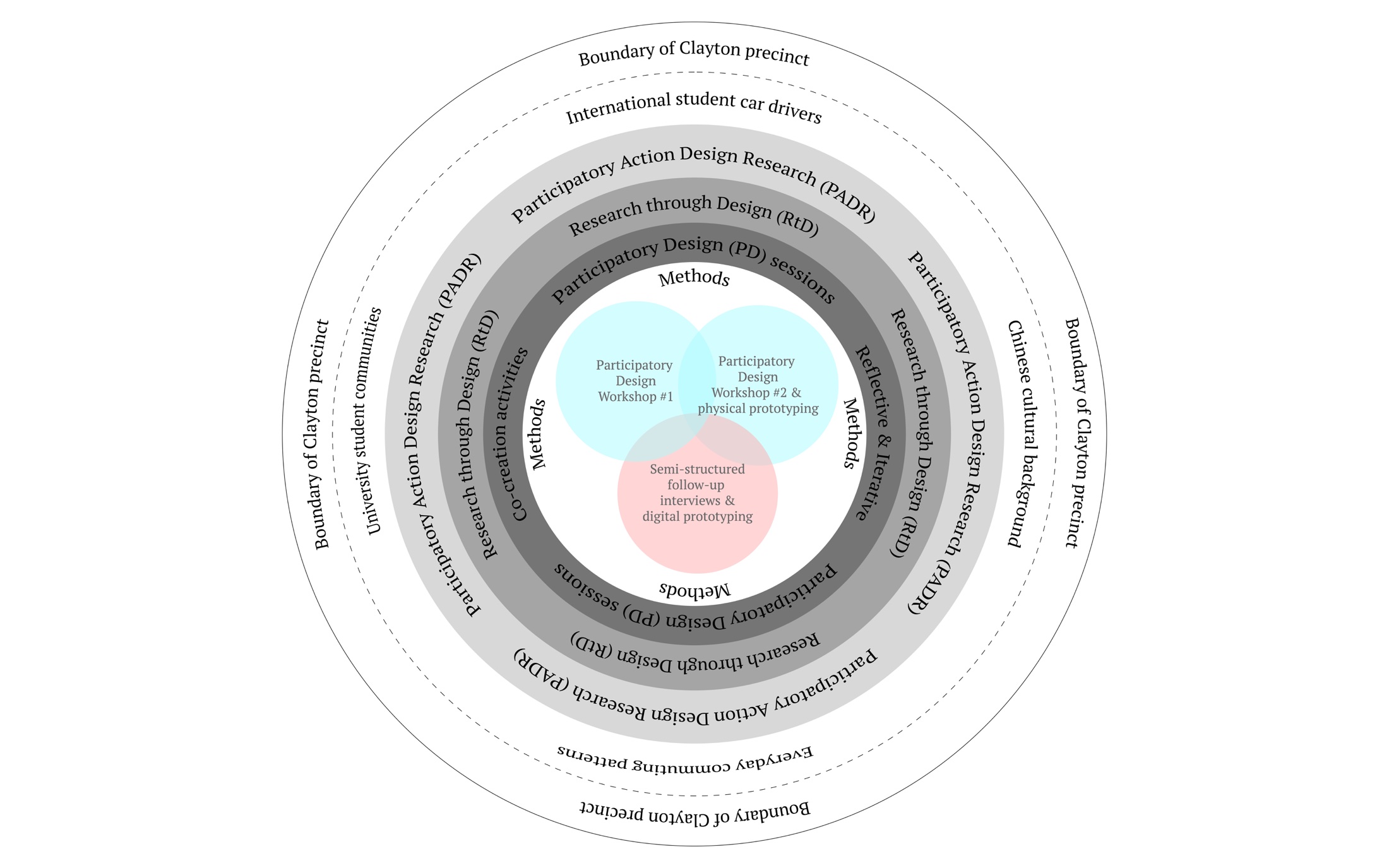
Design as both the enquiry and the way knowledge is made.
The project was positioned within practice-based design research. Understanding emerged through making, testing, reflection and iteration with people in the specific social and infrastructural setting of Clayton.
Research through DesignParticipatory Action ResearchConstructivist Grounded Theory
Research timeline
A recursive journey from understanding the system to making change discussable.
The PhD did not follow a simple discover-then-design sequence. Evidence, analysis and making repeatedly informed one another, with each prototype returning to participants as a new way to think, question and decide.
Phase 01
Frame the mobility system
I connected sustainable mobility policy, MaaS research and the conditions of Clayton’s suburban campus to define a bounded research problem and a plausible five-year design horizon.
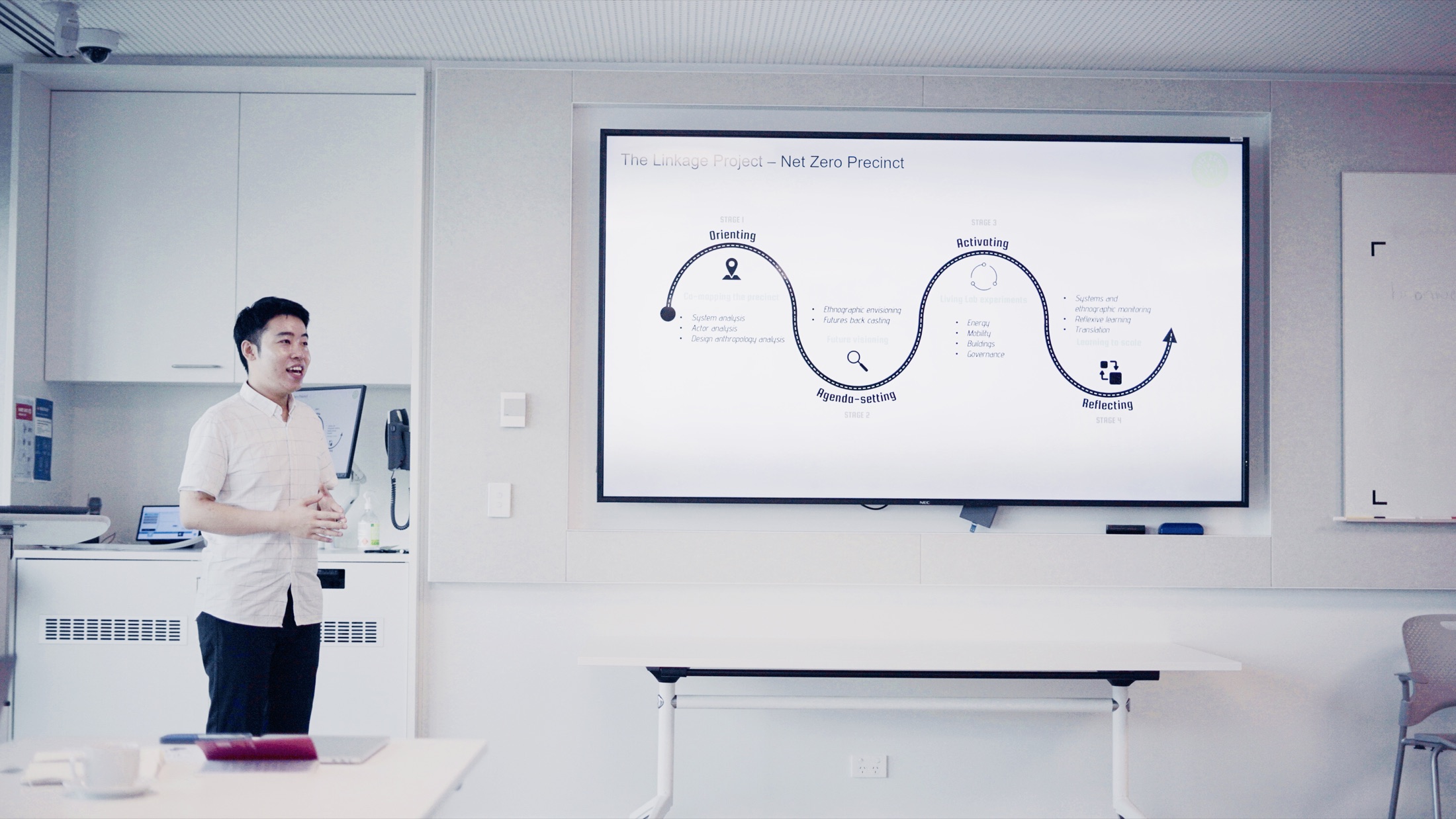
- Literature review
- Policy review
- Precinct mapping
Research outputResearch question, system boundary and initial conceptual framework
Phase 02
Build a situated account
I recruited ten international student drivers and documented how study, work, housing, cultural transition and local infrastructure shaped their daily travel decisions.
- Participant recruitment
- Contextual enquiry
- Journey mapping
Research outputParticipant contexts, mobility routines and an evidence base of barriers
Phase 03
Co-frame the challenge
The first participatory workshop moved from individual stories to shared priorities. Mapping and generative activities helped participants compare frictions, motivations and possible futures.
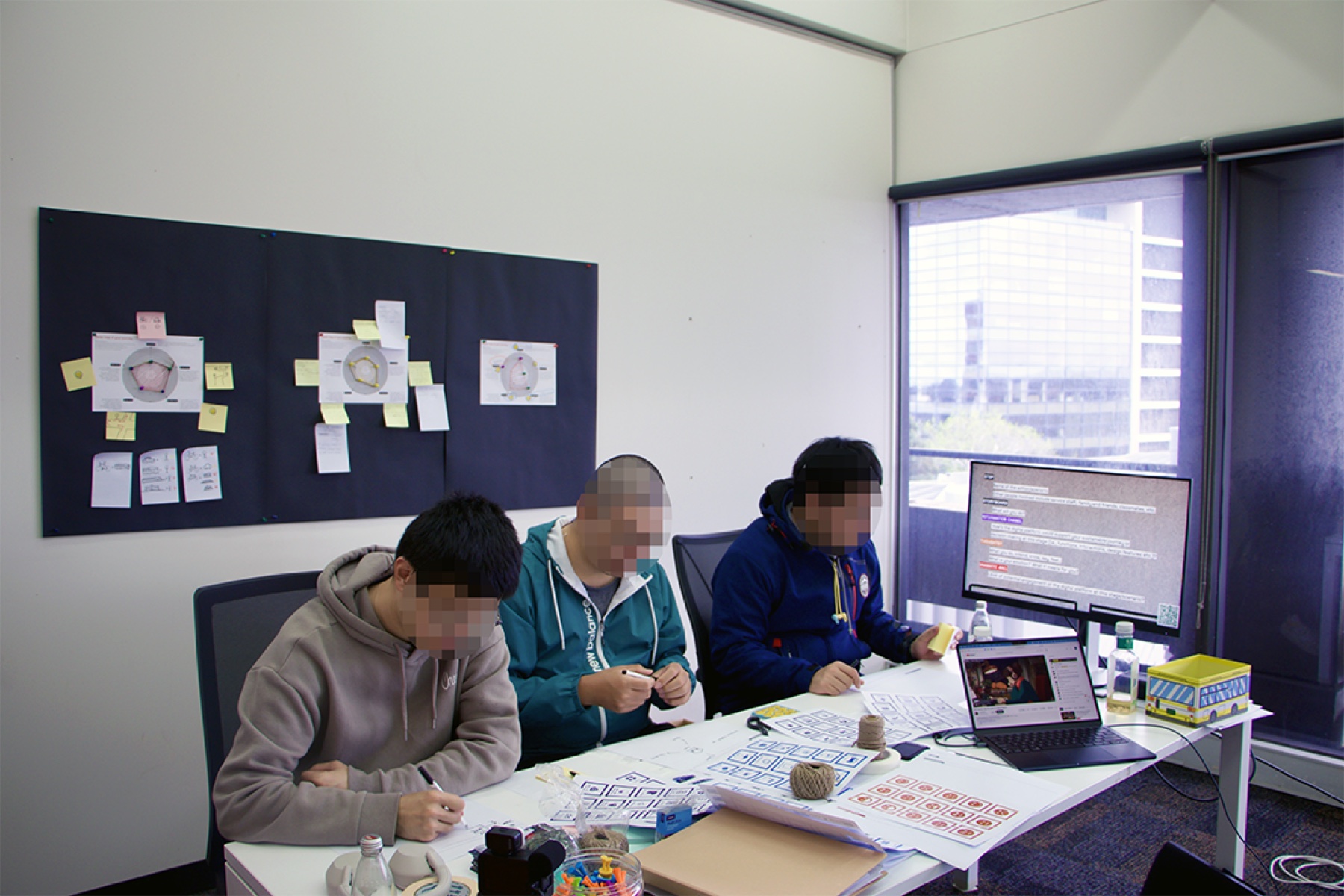
- Workshop 01
- Storytelling
- Co-mapping
Research outputCollective design priorities and early service propositions
Phase 04
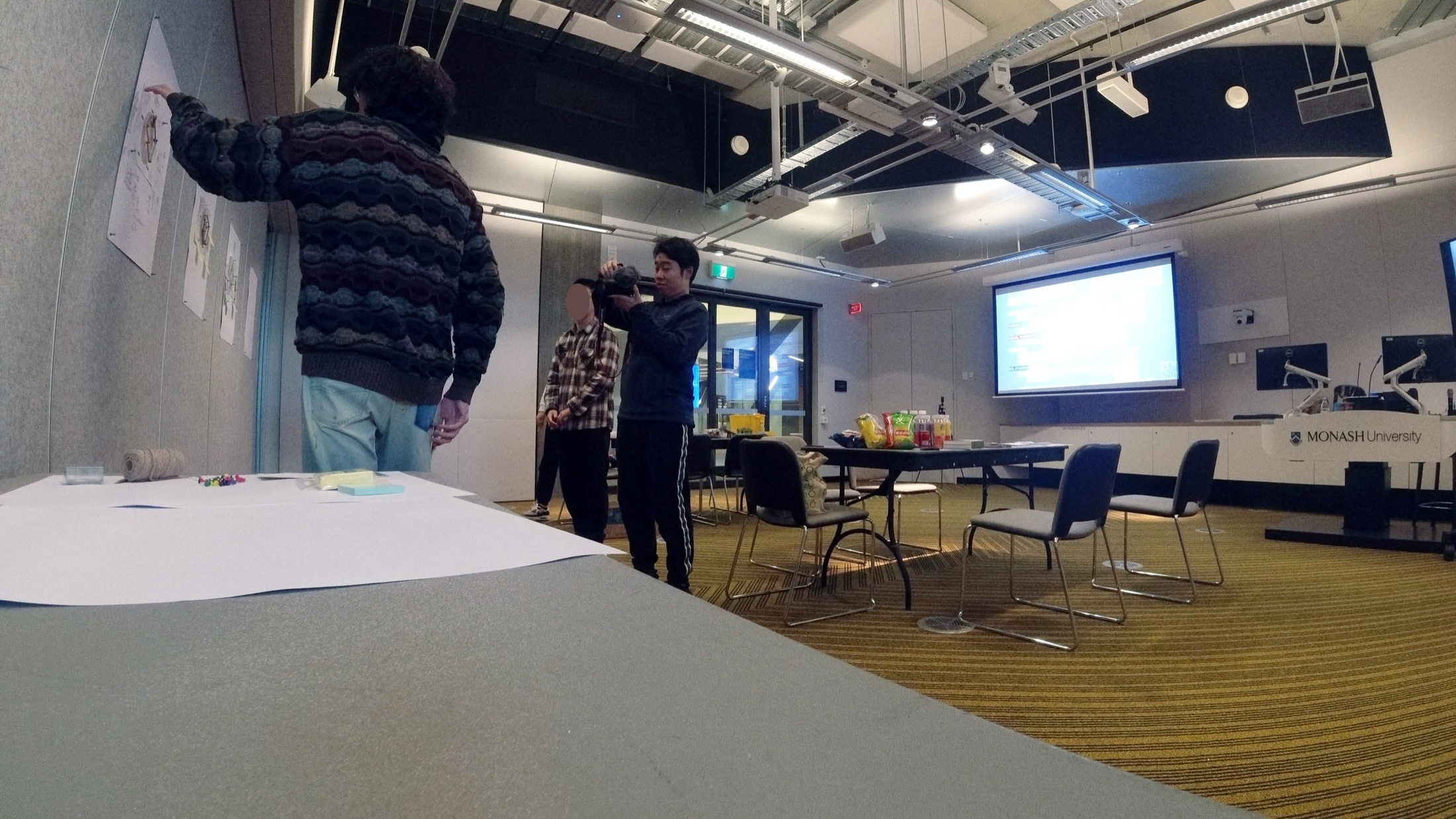
Analyse, make and return
I iteratively coded participant material, translated themes into service touchpoints and created interface cards and journey flows that could be questioned in the next research encounter.
- Grounded analysis
- Research through Design
- Rapid prototyping
Research outputTraceable links from participant evidence to prototype decisions
Phase 05
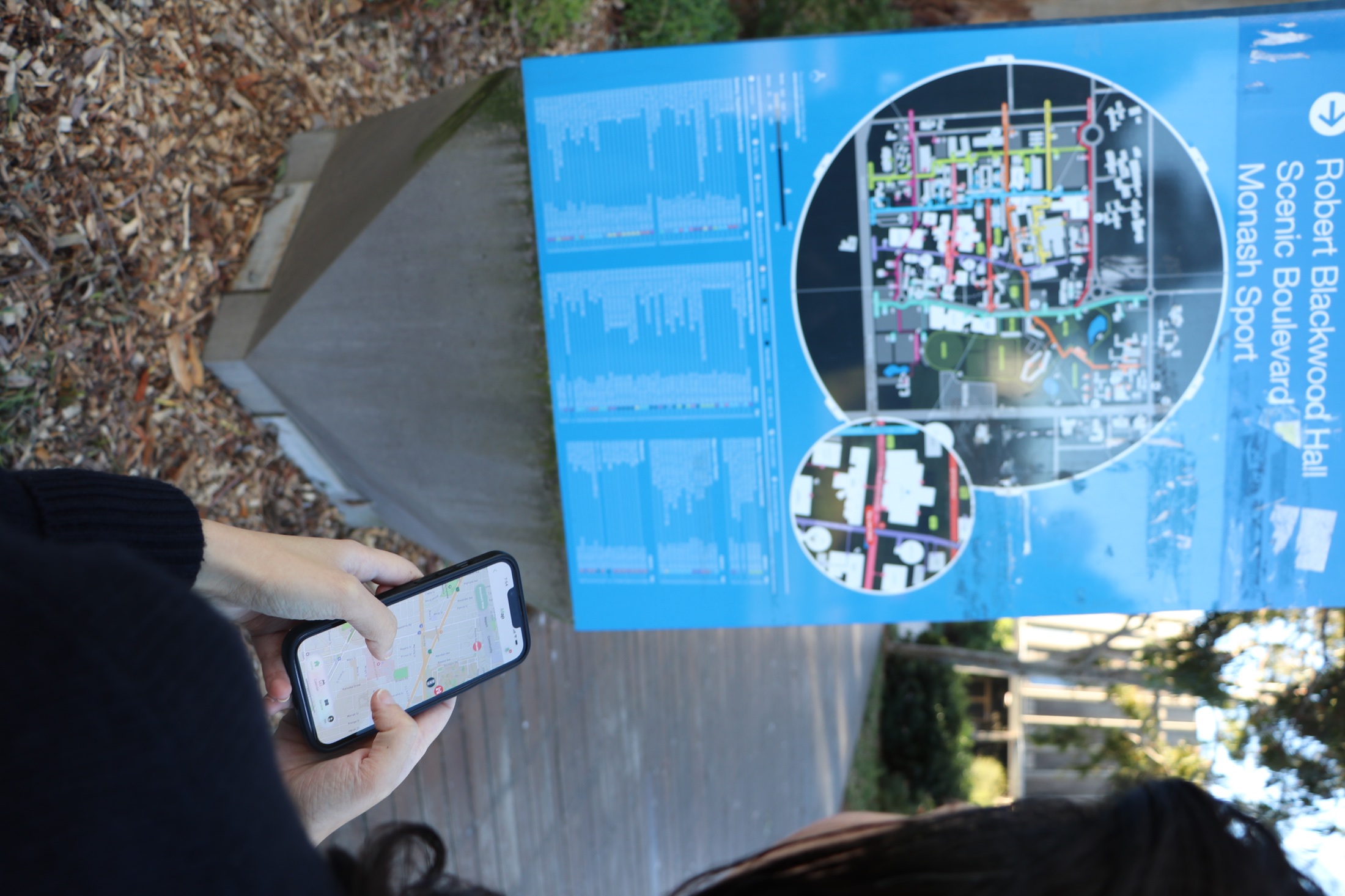
Evaluate through participation
In the second workshop, participants sequenced screens, reviewed the connected journey and co-ranked features. Follow-up interviews clarified why particular ideas built confidence or created friction.
- Workshop 02
- Co-ranking
- Follow-up interviews
Research outputRefined requirements for information, trust, wayfinding and feedback
Phase 06
Synthesise the research artefact
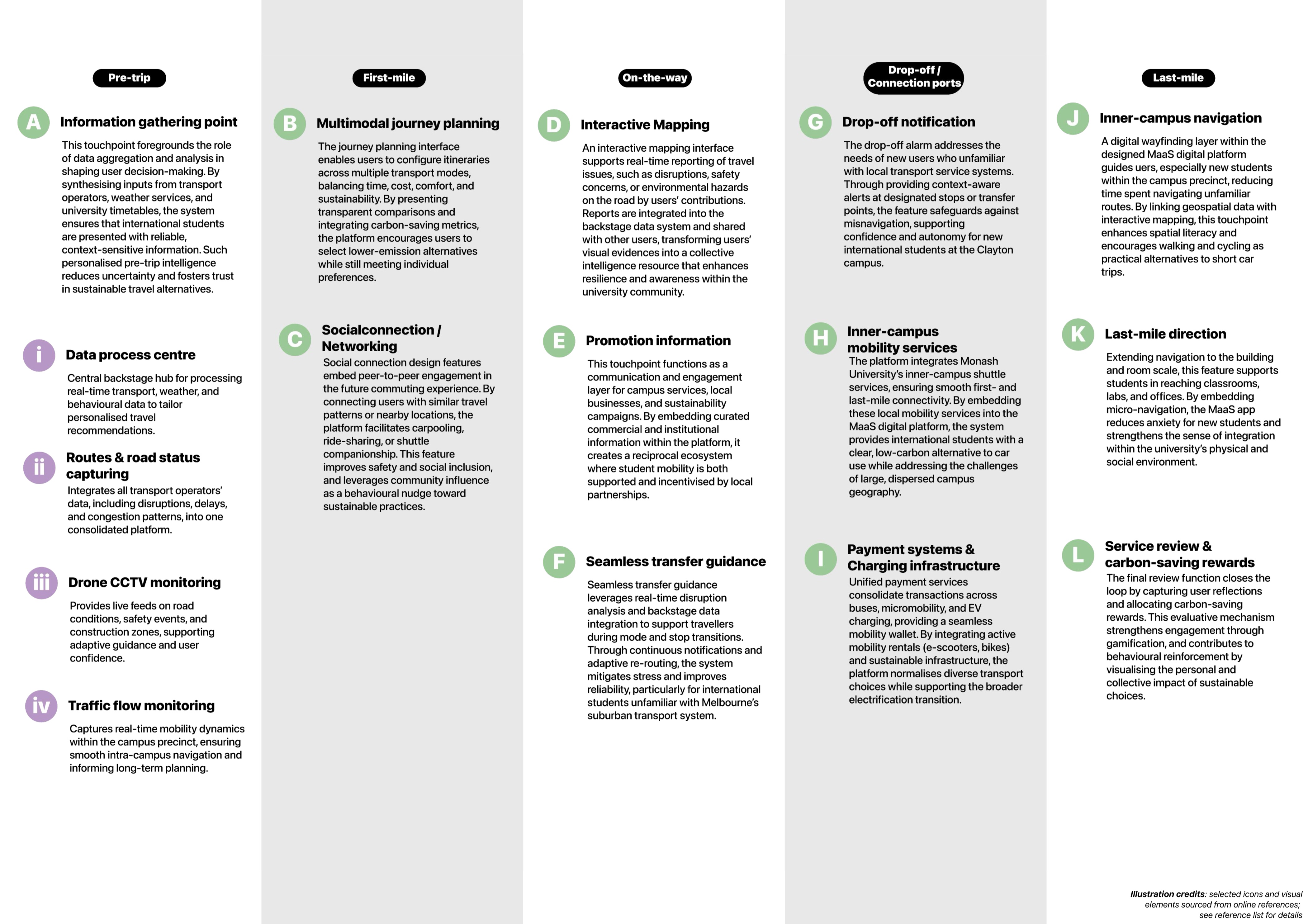
I brought the analysis into a five-stage service blueprint, an interactive MaaS prototype and a public exhibition, then reflected on their theoretical, methodological and practical contribution.
- Service blueprinting
- Interactive prototyping
- Reflective synthesis
Research outputGo Green! Monash, the exegesis and an exhibition-ready research narrative
Participatory process
Participants moved from narrators to co-designers.
Saying, doing and making enabled participants to externalise tacit travel knowledge, negotiate preferred futures and influence the platform’s service logic, rather than simply commenting on a finished interface.
Map the lived context
Field review, journey mapping and discussion surfaced routines, infrastructure constraints and moments of uncertainty.
Frame barriers together
Participants ranked frictions and translated individual experiences into shared design priorities.
Make possible services
Scenarios, interface cards and physical sequencing made future mobility touchpoints tangible and debatable.
Test and refine
Follow-up interviews and iterative digital prototyping clarified meaning, usability and contextual requirements.
Key findings
Sustainability was valued. Practical confidence decided.
Participants’ choices were not explained by environmental attitude alone. Mobility behaviour emerged from the interaction of personal history, suburban infrastructure, time pressure and perceived risk.
Personal history shapes preference
Earlier transport habits, current living conditions and the need to coordinate study, work and social obligations made convenience and predictability decisive.
Suburban infrastructure limits change
Service frequency, indirect connections and first- and last-mile gaps constrained participants who were otherwise willing to consider public and active transport.
Time sensitivity reinforces driving
Irregular off-peak and evening services conflicted with tight schedules. Driving offered a stronger sense of temporal control and dependable arrival.
Environmental intent meets practical trade-offs
Concern for sustainability was genuine, but distance, safety, comfort and uncertainty produced a persistent value-action gap in everyday decisions.
Design response
Research insights became service requirements.
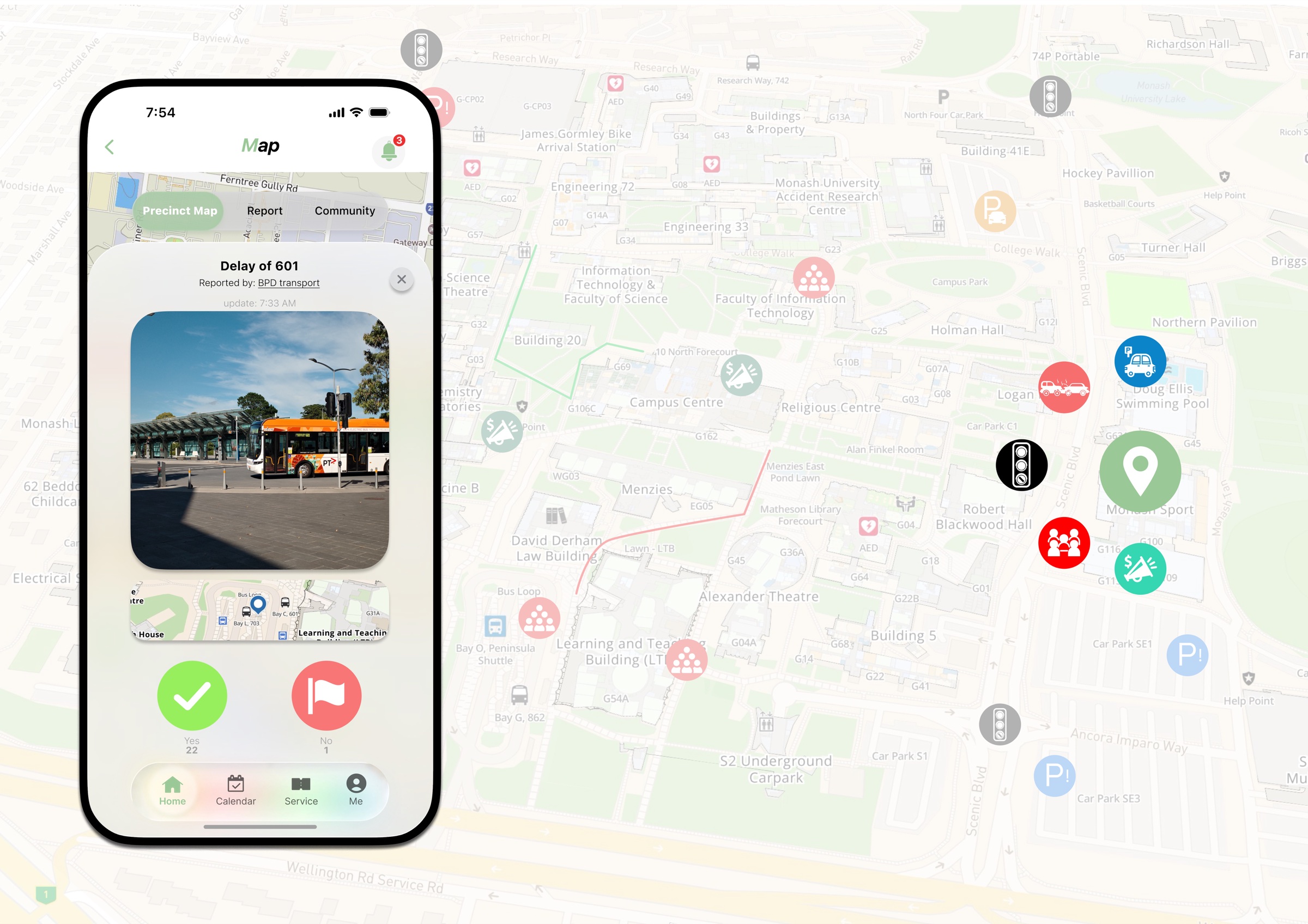
Go Green! Monash translated contextual and cultural insight into an early digital MaaS proposition spanning pre-trip, first-mile, on-the-way, connection ports and last-mile travel.
Local, real-time multimodal planning
Bring public transport, walking paths, campus shuttles, cycling and carpool availability into one context-specific journey view.
Planning around real schedules
Connect route recommendations with academic and personal calendars so arrival confidence becomes part of sustainable mode choice.
Personalised local orientation
Use onboarding, campus wayfinding and support at uncertain transfer points to build familiarity with Melbourne’s suburban transport network.
Rewards and social feedback
Make carbon savings tangible through contextual incentives, collective progress and community features that support, rather than shame, behaviour change.
Design outcome, five-stage service blueprint
One connected journey, from planning to arrival.
Explore the blueprintContribution to knowledge
Three connected forms of research contribution.
The work contributes a situated account of mobility transition, an integrative participatory methodology and a tangible design proposition that makes system change visible and discussable.
International students as agents of change
Mobility identities are negotiated through personal history, cultural adaptation and systemic constraints, rather than fixed user traits.
Participation as knowledge production
The integrated framework positions lived experience and user agency as foundations for conceiving, designing and validating future mobility services.
A research artefact for transition
The prototype turns interpretive findings into interaction pathways, making sustainable mobility choices experiential rather than abstract.
Scope and limitations
This was an exploratory, practice-based study with ten participants from Chinese cultural backgrounds in one suburban university setting. The prototype was conceptual rather than operational; future work requires live transport data, broader participant groups and longitudinal evaluation.
Continue exploring